HIGH-TEMPERATURE SUPERCONDUCTIVITY. BIPOLARON MECHANISM
Victor Dmitrievich Lakhno.
HIGH-TEMPERATURE SUPERCONDUCTIVITY. BIPOLARON MECHANISM
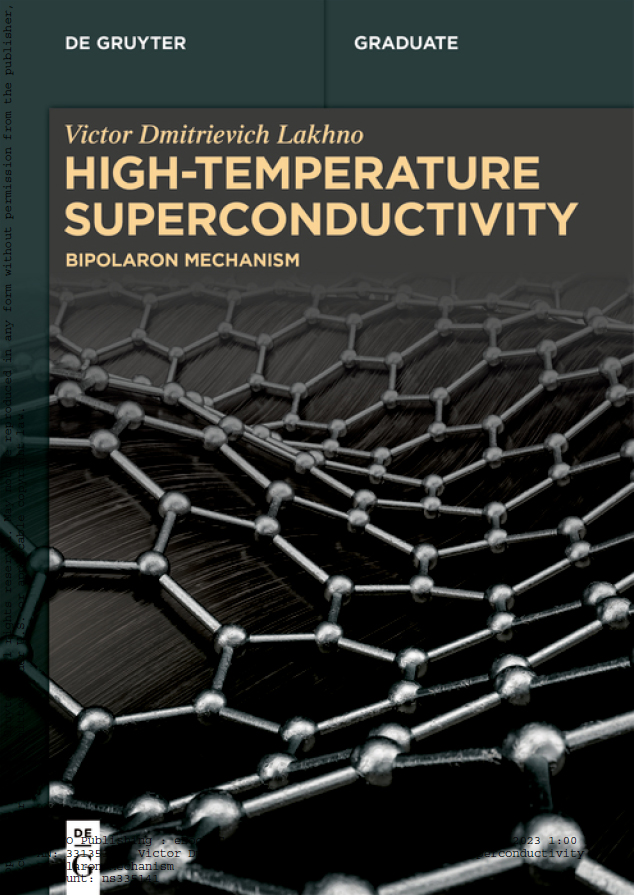
High temperature superconducting theory drew controversy after the discovery of
superconductors at close to room temperatures. However, a consistent microscopic
theory of HT superconductivity based on bipolaron mechanism leads to a better
understanding of microscopic and macroscopic description. By presenting aspects
of superconductivity now joined in a strict theory rather than separate models this
work is especially useful for graduate students.
Open in PDF: 
Book review
Book Review: V.D. Lakhno, High-Temperature Superconductivity (De Gruyter, 2022)
The Quantum Renaissance of Translational Invariance: Beyond the Myth of Self-Trapping
In modern solid-state physics, a peculiar paradox persists: while we build theories for ideal crystals, we abruptly pivot to the language of localized, symmetry-breaking states whenever strong electron-phonon coupling is involved. Victor Lakhno’s book, High-Temperature Superconductivity, directly challenges this status quo, offering a rigorous translationally invariant (TI) theory of the polaron.
The Central Thesis
The author’s primary argument is that the concept of “self-trapping” in an ideal crystal is a myth—an artifact born from the unjustified application of the adiabatic approximation. Lakhno demonstrates that a strong-coupling large polaron in a TI state is always energetically lower than its non-translationally invariant (NSI) localized counterpart. This distinction is not merely a mathematical nuance; it is the fundamental key to unlocking the mechanism of superconductivity.
A Critical Shift in Methodology
Lakhno provides a compelling critique of classical approaches, including the Pekar ansatz and the Bogoliubov-Tyablikov method. He argues that these models fail by attempting to describe a quantum object using classical lattice displacements (the “classical component”). Instead, the book introduces a framework based on squeezed quantum states of phonons.
- This approach avoids the “infinite mass catastrophe” traditionally associated with strong coupling.
- In the TI framework, the polaron remains mobile and coherent, regardless of the coupling strength.
- Translational symmetry is preserved explicitly throughout the calculation, removing the need for artificial symmetry restoration.
Reimagining Superconductivity
The most ambitious section of the book addresses High-Temperature Superconductivity (HTSC). Rejecting the mainstream dogma that strong-coupling polarons are too heavy to form a condensate, Lakhno demonstrates the possibility of bipolaron condensation. Since TI bipolarons possess a finite (and manageable) effective mass, the critical temperature
can theoretically reach room-temperature values—a result unattainable within the constraints of standard BCS theory or NSI-based models.
Why This Matters Now
Lakhno’s work is more than a theoretical exercise. It exposes the roots of the stagnation in HTSC theory, pointing out how reliance on DFT and other methods prone to “spurious localization” has led the field into a dead end. By returning to the purity of quantum mechanical symmetry, the author bridges the gap between strong coupling and high mobility.
Verdict
High-Temperature Superconductivity (2022) is essential reading for researchers ready to question 50-year-old textbook dogmas. Lakhno offers an elegant, rigorous solution to a problem that was long considered “solved” but was, in fact, merely obscured by adiabatic approximations. This book is a landmark step toward a theory of superconductivity rooted in the intrinsic properties of the quantum field rather than the phenomenology of defects.