The book is published
Victor Dmitrievich Lakhno.
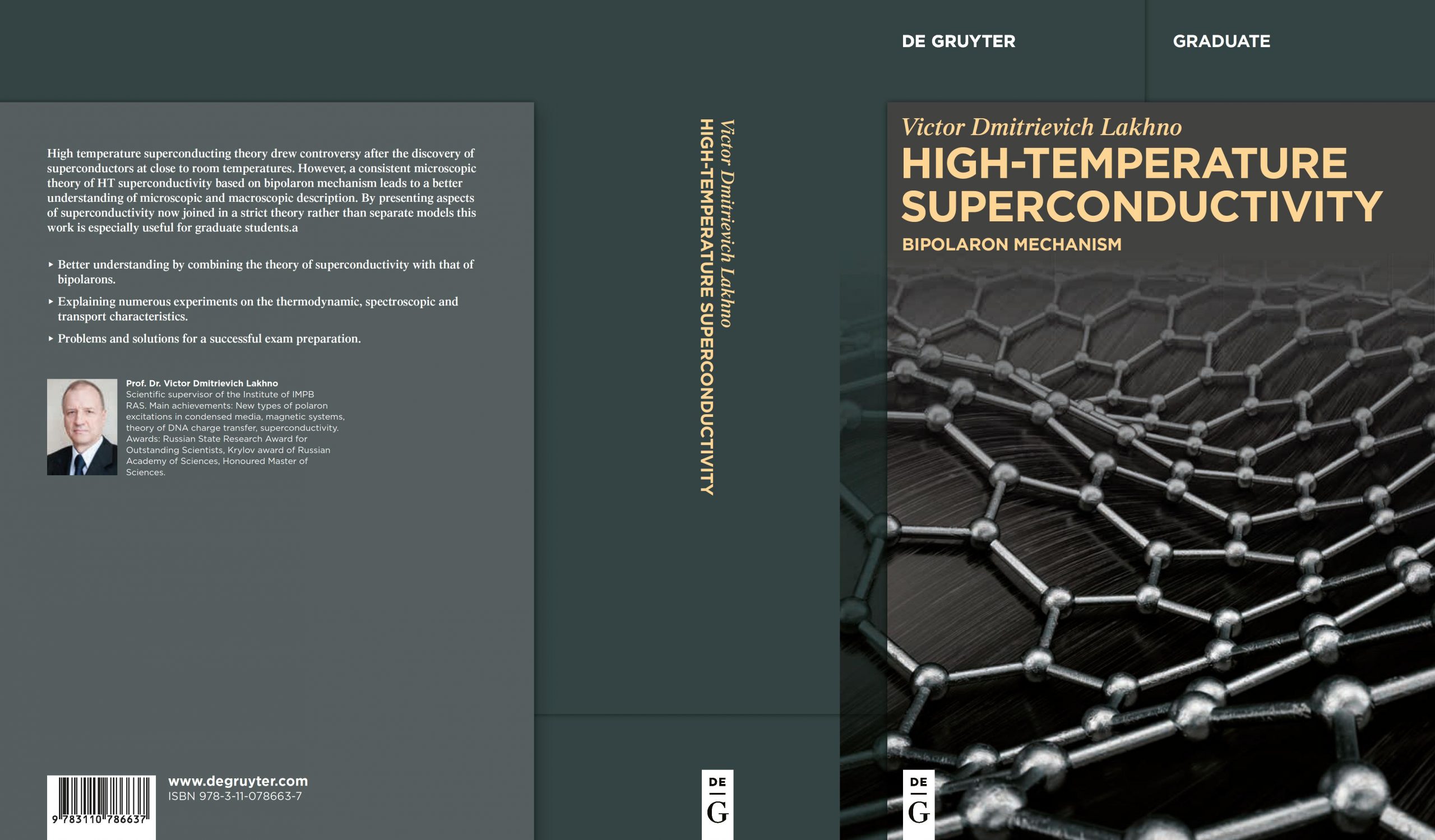
HIGH-TEMPERATURE SUPERCONDUCTIVITY. BIPOLARON MECHANISM
High temperature superconducting theory drew controversy after the discovery of
superconductors at close to room temperatures. However, a consistent microscopic
theory of HT superconductivity based on bipolaron mechanism leads to a better
understanding of microscopic and macroscopic description. By presenting aspects
of superconductivity now joined in a strict theory rather than separate models this
work is especially useful for graduate students.a
-
- Better understanding by combining the theory of superconductivity with that of
bipolarons. - Explaining numerous experiments on the thermodynamic, spectroscopic and
transport characteristics. - Problems and solutions for a successful exam preparation.
- Better understanding by combining the theory of superconductivity with that of
Prof. Dr. Victor Dmitrievich Lakhno
Scientifi c supervisor of the Institute of IMPB
RAS. Main achievements: New types of polaron
excitations in condensed media, magnetic systems,
theory of DNA charge transfer, superconductivity.
Awards: Russian State Research Award for
Outstanding Scientists, Krylov award of Russian
Academy of Sciences, Honoured Master of
Sciences.

This monograph represents a critical reexamination of the variational method in polaron theory. The author convincingly demonstrates the priority of translation-invariant states over localized ones. The main achievement is the demonstration that the TI polaron is an energetically more favorable ground state than that predicted by the Landau-Pekar asymptotics. This is a key link in understanding the mechanisms of high-temperature superconductivity in cuprates and biological macromolecules.
Lakhno’s book (De Gruyter, 2022) poses a fundamental question: why did we believe in polaron localization for 70 years? A deep algorithmic analysis of the text reveals that the author has found a loophole in Lieb’s theorems. It turns out that the Lieb limit is only valid for localized functions in . The transition to translation-invariant (TI) states yields energies BELOW this limit. This changes everything in high-temperature superconductivity theory. If the polaron is not “stuck” in the lattice, then room-temperature superconductivity is a matter of properly tuning the parameters of TI bipolarons. A must-read for anyone seeking a way out of the impasse of classical models.